


Used Bachiller Jet-Mill Msb305 for sale (10,642)
Sort results
- Lowest price Highest price
- Newest listings Oldest listings
- Shortest distance Farthest distance
- Newest year of manufacture Oldest year of manufacture
- Latest update Oldest update
- Manufacturer A to Z Manufacturer Z to A
- Relevance
- Lowest price
- Price
- Highest price
- Price
- Newest listings
- Release date
- Oldest listings
- Release date
- Shortest distance
- Distance
- Farthest distance
- Distance
- Newest year of manufacture
- Year of construction
- Oldest year of manufacture
- Year of construction
- Latest update
- Update
- Oldest update
- Update
- Manufacturer A to Z
- Manufacturer
- Manufacturer Z to A
- Manufacturer
- designation from A to Z
- Description
- designation from Z to A
- Description
- Model from A to Z
- Model
- Model from Z to A
- Model
- Lowest reference
- Ref.No.
- Highest reference
- Ref.No.
- Shortest runtime
- Runtime
- Longest duration
- Runtime
- Relevance
- Relevance
Listing


 Rheda-Wiedenbrück
7,705 km
Electric 150-300bar 18-40l/min.
DEN-JETCE15
Call
Year of construction: 2022, operating hours: 1 h, condition: as good as new (ex-display), The CE15 series is an electrically powered high pressure cleaner.
This model is the ideal tool for general cleaning jobs. Built into a stainless steel frame, this robust pressure washer is easy to move and can be equipped with various accessories such as rotor nozzles, chemical injectors and a sandblasting kit. Similar but no Dynajet, Falch, Kärcher, Oertzen, etc.
Models available:
Kjdshf Na Sopfx Ak Eslt
-----
CE15-series L/min
CE15-150 bar 40 15 hp water blaster unit 50Hz
CE15-150 bar 40 15 hp water blaster unit 50Hz with start/stop
CE15-170 bar 35 15 hp water blaster unit 50Hz
CE15-170 bar 42 15 hp water blaster unit 60Hz
CE15-170 bar 35 15 hp water blaster unit 50Hz with start/stop
CE15-170 bar 42 15 hp water blaster unit 60Hz with start/stop
CE15-200 bar 30 15 hp water blaster unit 50Hz
CE15-200 bar 36 15 hp water blaster unit 60Hz
CE15-200 bar 30 15 hp water blaster unit 50Hz with start/stop
CE15-200 bar 36 15 hp water blaster unit 60Hz with start/stop
CE15-300 bar 18 15 hp water blaster unit 50Hz
CE15-300 bar 22 15 hp water blaster unit 60Hz
CE15-300 bar 18 15 hp water blaster unit 50Hz with start/stop
CE15-300 bar 22 15 hp water blaster unit 60Hz with start/stop
General specifications:
-----
Drive motor power: 11,2 kW (50Hz) / 13 kW (60Hz)
Volt: 400V (50Hz) - 440V (60Hz)
Amp: 22.8A (50Hz) - 23.8A (60Hz)
Dimensions: 690 mm x 600 mm x 900 mm
Weight: 85 kg
Standard accessories included.
Listing
 Rheda-Wiedenbrück
7,705 km
Electric 200-250bar 15-25l/min.
DEN-JETCE10
Call
Year of construction: 2022, operating hours: 1 h, condition: as good as new (ex-display), The CE10 series is an electrically powered high pressure cleaner.
This model is the ideal tool for general cleaning jobs. Built into a stainless steel frame, this robust pressure washer is easy to move and can be equipped with various accessories such as rotor nozzles, chemical injectors and a sandblasting kit. Similar but no Dynajet, Falch, Kärcher, Oertzen, etc.
Models available:
-----
CE10-series L/min
CE10-200 bar 21 10 hp water blaster unit 50Hz
CE10-200 bar 25 10 hp water blaster unit 60Hz
CE10-200 bar 21 10 hp water blaster unit 50Hz with start/stop
CE10-200 bar 25 10 hp water blaster unit 60Hz with start/stop
CE10-250 bar 15 10 hp water blaster unit 50Hz
CE10-250 bar 18 10 hp water blaster unit 60Hz
CE10-250 bar 15 10 hp water blaster unit 50Hz with start/stop
CE10-250 bar 18 10 hp water blaster unit 60Hz with start/stop
Klsdehf Na Ispfx Ak Eet
General specifications:
-----
Drive motor power: 7,5 kW (50Hz) / 9 kW (60Hz)
Volt: 400V (50Hz) - 440V (60Hz)
Amp: 15.1A (50Hz) - 15.6A (60Hz)
Dimensions: 690 mm x 560 mm x 900 mm
Weight: 70 kg
Standard accessories included.
Listing


 Iserlohn
7,695 km
Lead/traction spindle lathe
JETGHB-1330

Call
Condition: good (used), Year of construction: 2010, LZ-Lathe Fabr.JET Type :GHB-1330 Bj.2010
with 3 ash digital indicator, 3 jaws lathe chuck DM 160 mm tool holder Multifix size A, 2 steady rests coolant device.
Turning diameter overbed: 330 mm
Turning diameter over face: 197 mm
Center width: 750 mm
Spindle speeds: 70-2000 rpm
Kjdpfx Aksqwgzqo Eelt
spindle bore : 38 mm
Machine in good condition from the training workshop
Machine documentation available .

Get information now
+49 201 857 86 122
+49 201 857 86 122
List now
*per listing / month
Listing


 Söding
8,431 km
Wide belt sander
JetDDS-237
Call
Condition: excellent (used), !!!DEMONSTRATION MACHINE!!!
For sale is an as-new JET DDS-237 sanding machine with a maximum sanding width of 940 mm.
The machine is in excellent condition and has been refurbished and inspected by our specialist staff. (Fully functional)
Technical data:
- Double drum sander JET DDS-237
- Motor: 400 V / 7.5 HP
- Sanding drum speed: 1,400 rpm
- Feed speed: 3 m/min
- Max. sanding width: 940 mm
- Sanding thickness: 0.8 to 133 mm
- Minimum workpiece length: 230 mm
- Sanding drum dimensions: 152 x 940 mm each
- Sanding belt width: 75 mm or 100 mm
- Extraction port: 2 x diameter 100 mm
- Dimensions (LxWxH): 1,090 x 1,420 x 1,090 mm
- Weight: 440 kg
The machine is located in A-8561 Söding and can be inspected and collected at any time during our opening hours. Subject to prior sale!
Ksdex Sqzvopfx Ak Eslt
Related terms: column drill, pillar drill, drilling machine
Reference: R-D1618
Listing


 Schweinfurt
7,928 km
Water jet cutting system
Maximator JET2010 Premium TAC
Call
Condition: refurbished (used), Year of construction: 2019, operating hours: 5,900 h, functionality: fully functional, Waterjet Cutting System 2010 Premium TAC
From previous ownership, serviced thoroughly after complete service in 02/2026, inspected and ready for operation. Maximator JET certificate available.
Availability: in 4 weeks
Year of manufacture cutting table: 2019
Operating hours cutting table: 5,900 hrs
• Effective cutting area: 2,000 mm (gantry) x 1,000 mm
• Z-axis CNC vertical clearance 200 mm with Quick UP
• Cutting head TAC12, A/B +/- 12°
• Automatic height sensing and collision protection
• CNC control NUM
• Rittal electrical cabinet on wheels
• Operator PC with LED monitor, splash-proof keyboard and mouse
• Waterjet software SmartCut powered by IGEMS; subscription-based
• Handheld operator device
• Laser for position detection
• Cutting valve MJ 100
• Abrasive head aJET 3D
• CNC abrasive dosing unit with intermediate hopper
• Abrasive storage container 1,200 kg with automatic pressure feed system
• High-pressure piping on the axes up to the cutting head
• Safety system with light barriers
• Water tank with heavy-duty support slats
• Reference edge on X and Y
• Machine feet with precision wedge shoes
• 1-year or 1,200 operating hours warranty
• High-pressure pump HYTRON 40.30, 30 kW, YOM 2006, 28,852 hrs, retrofit in 10/2025 with warranty, new pulsation damper with TÜV certification
Kljdpsxvqvfjfx Ak Est
Technical data and prices subject to change and errors excepted.
Sale subject to prior sale.
Listing
 Sennfeld
7,932 km
Lathe / Turning machine
JetJWL 1440 VA-M
Call
Condition: new, Equipment: rotational speed of tool magazine infinitely variable, Heavy grey cast iron machine bed for optimal smooth running and stability when working with unbalanced workpieces
Headstock can be moved along the entire machine bed, rotatable by 360° with detents at 0, 30, 60, 90, 135, 180, and 270 degrees
Variomatic speed control, infinitely adjustable from 280 to 2500 rpm via rotary knob at the end of the headstock
Integrated spindle indexing device 36 x 10°
Kljdsw A Rqfepfx Ak Eot
Spindle lock at the front of the headstock for easy changing of workholding fixtures
Double wedge clamp for tool rest and extension arm, particularly slip-resistant and efficient
Tailstock with robust trapezoidal thread, 108 mm quill travel with scale, 9 mm through hole
Listing


 Wiefelstede
7,607 km
SK50 cutter head
TAC MILLØ 100 mm
Call
Condition: good (used), Cutter head, milling chuck, carbide cutter, indexable insert cutter, face milling head, milling head
Kljdpfx Aob A Ihdsk Eet
-Diameter: Ø 100 mm
-Number of teeth: 6
-Indexable inserts: Carbide
-Recording: SK50
-Weight: 4.5 kg
Listing


 Seva
Seva
7,941 km
Pressure vessel
BachillerBachmix PC200
Call
Condition: excellent (used), tank capacity: 340 l, total length: 2,450 mm, total width: 1,350 mm, total height: 1,950 mm, inner diameter: 800 mm, operating temperature: 140 °C, negative pressure: -1 Pa, Vacuum reactor model BACHMIX with a total capacity of 340 liters, manufactured by BACHILLER.
Mounted on a stainless steel frame.
Kjdpfxsxn Ngto Ak Eslt
Hydraulic system for lid lifting.
Equipped with three agitation systems:
Anchor-type agitator with PTFE scrapers + two axial turbine dual-blade impellers at different heights
Cowless agitator
Turrax agitator
Listing


 Kuchl
Kuchl
8,266 km
Other wood sanding machines
JetJSG 31A
Call
Condition: like new (used), DEMONSTRATION MACHINE
For sale is an as-new JET belt and disc sander JSG-31A with a 300 mm disc diameter. The demonstration unit is in original condition, so you receive the full warranty.
Technical specifications:
- Motor power: 1.1 kW / 1.5 HP / 230 V
- Disc diameter: 300 mm
- Disc speed: 2,700 rpm
- Disc sanding table size: 230 x 420 mm
- Sanding table tilt range (disc): -45° to +15°
- Belt dimensions: 150 x 1,220 mm
- Belt speed: 11.5 m/sec
- Belt sanding table size: 190 x 330 mm
- Sanding table tilt range (belt): -45° to 0°
- Sanding arm tilt range (belt): 0° to 90°
- Extraction port: 100 mm
- Dimensions (LxWxH): 830 x 700 x 1,400 mm
- Weight: 124 kg
The machine is located in A-5431 Kuchl and can be inspected at any time during our opening hours. Subject to prior sale!
Shipping (by freight forwarder):
Austria: € 70.00 incl. VAT
Germany: € 90.00 incl. VAT
South Tyrol: € 110.00 incl. VAT
Related terms: JET JSG-31A, belt sander, disc sander, belt, wood, combination sander, 150x1220, 300 mm, sanding machine, professional, workshop, stationary, machine
Klodpjycc Tdjfx Ak Eet
Reference: R-A0117
Listing


 Kuchl
Kuchl
8,266 km
Edge sanding machine
JetOES-80CS
Call
Condition: like new (used), DEMONSTRATION MACHINE
For sale is an as-new JET Oscillating Edge Sander OES-80CS featuring a 400V motor / 2,800 watts and a belt speed of 17 m/s.
The demonstration machine is in its original condition, so you receive the full warranty.
Ksdpfoyb Sfaox Ak Eolt
Technical Data
- Motor: 400 V / 2,800 watts
- Belt speed: 17 m/s
- Belt dimensions: 150 x 2,260 mm
- Belt inclination: 90° – 180°
- Belt table dimensions: 810 x 180 mm
- Extension table: 250 x 300 mm
- Oscillation stroke: 13 mm
- Oscillations per minute: 108
- Extraction port diameter: 100 mm
- Dimensions: 1,300 x 670 x 1,230 mm
- Weight: 124 kg
The machine is located in A-5431 Kuchl and can be inspected at any time during our opening hours. Subject to prior sale!
Freight shipping:
Austria: €70.00 incl. VAT
Germany: €90.00 incl. VAT
South Tyrol: €110.00 incl. VAT
Related terms: JET OES-80CS, edge sander, oscillating, woodworking, 400V, machine, belt sanding technology, workshop equipment, industrial quality, 150x2260, belt
Reference: R-A0117
Listing


 Kuchl
Kuchl
8,266 km
Mortiser
Jet719-AS
Call
Condition: like new (used), DISPLAY MODEL
For sale is an as-new JET Mortising Machine 719-AS equipped with a powerful motor for demanding applications. The display model is in its original condition, so you benefit from the full warranty.
Technical specifications
- Motor: 230 V / 1,300 W
- Spindle speed: 1,450 rpm
- Max. chisel size (hard/softwood): 19 x 19 / 25 x 25 mm
- Keyless drill chuck: 13 mm
- Max. workpiece height: 195 mm
- Max. chisel stroke: 200 mm
- Table travel (longitudinal/cross): 400 / 100 mm
- Table tilt: 0 – 35°
- Table dimensions: 520 x 180 mm
- Workpiece stop: 520 x 90 mm
- Max. distance from chisel center to stop: 100 mm
- Machine dimensions: 650 x 500 x 1760 mm
- Weight: 125 kg
The machine is located in A-5431 Kuchl and can be inspected at any time during our business hours. Subject to prior sale!
Klsdoyb Sbnepfx Ak Est
Shipping by freight forwarder:
Austria: €75.00 incl. VAT
Germany: €95.00 incl. VAT
South Tyrol: €125.00 incl. VAT
Related terms: JET 719-AS, mortising machine, slot mortising, wood jointing, 230 V drive, 1300W power, professional tool, workshop equipment, precision engineering, woodworking
Reference: R-A0117
Listing


 Slovenia
8,509 km
Table boring mill
CNC BORING MILL WOTAN RAPID 1RAPID 1
Call
Condition: excellent (used), Year of construction: 2001, AN VERY RARE OPORTUNETEY TO BUY AN EXCELLENT MACHINE WITH HUGE AMOUT OF TOOLINGS, DRAWERS, CLAMPING EQUIPMENT...
CNC BORING MILL WOTAN RAPID 1 RETRIFITTED 2001 WITH HUGE AMOUNT OF OVER 450 TOOLING
VERY LOW HOURS
WORKING TIME DATA:
CONTROL ON: 8001 H
MACHINE POWER ON: 13692H
PROGRAM RUN: 4650 H
SPINDLE S1 TIME: 4690 H
AXIS TIME: 4568H
Ksdpsvkkf Hefx Ak Eelt
HYDRAULIC ON TIME: 12702 H
WE OFFER AN STUNNING EXCELLENT CONDITION WOTAN CNC RAPID 1 WITH HUGE AMOUNT OF TOOLINGS, FOR A SPECIAL STAINLESS WORK.
MACHINE HAVE HEIDENHAIN 530 CONTROLS
TECHNICAL DETAILS:
SPINDLE SPEED : 6,3-1600 U/Min
SPINDLE MOVE : Y AXIS : 1250 mm
DRILLING SPINDLE MOVE: Z AXIS: 600 mm
W : 1000 mm
X : 2000 mm
B: 360.000 DEGREE
SPINDLE DIAMETER: 105mm
TOOL HOLDER: ISO 50 WITHOUT TOOL CHANGER
CLAMPING: HIDRAULIC
MAX TABLE LOAD: 6000 KG
TABLE: 1120 X 1400
NUT -BILD 7 ; 22H7
INDEXING 4 X 90 DEGREE
TOTAL WEIGHT: 16000 KG
DIMENSION OF MACHINE: LENGHT 4800 X BREIT 4665 X HEIGHT 4200
Listing


 Miechucino
8,056 km
Drum sander JET DDS 225
JetDDS-225
Call
Condition: used, Year of construction: 2008, functionality: fully functional, grinding width: 635 mm, grinding height: 133 mm, – Year of manufacture: 2008
TECHNICAL SPECIFICATIONS:
– Rated power: 5550 W
– Actual power: 3700 W = 3.7 kW
– Max. sanding width: 635 mm
Kledpfx Aow Ip Huek Est
– Max. workpiece thickness: 133 mm
– Min. workpiece thickness: 0.8 mm
– Min. workpiece length: 230 mm
– Sanding rollers: 2 x ø 152 x 635 mm
– Height adjustment for the second roller
– Speed: 1400 rpm
– Sanding belt width: 600 mm
– Two feed rates
– Machine dimensions (L/W/H): 110 / 110 / 110 cm
– Weight: 332 kg
Listing


 Zheng Zhou Shi
11,505 km
Ball mill for powder and mining plant
Mingyuan Ball Mill For Fine PowderPowder grinding mill for coal, silica
Call
Condition: new, functionality: fully functional, power: 55 kW (74.78 HP), Year of construction: 2026, Ball Mill for Powder and Mining Plant: Structure, Function, and Technical Details
A ball mill is a key grinding machine widely used in mining, metallurgy, cement, chemical, and powder-making industries. It is designed to grind various ores and other materials into fine powder through impact and attrition between steel balls and the material inside a rotating cylindrical shell. In mining plants, ball mills are essential for ore beneficiation, preparing materials for flotation, magnetic separation, or leaching processes. In powder production, they ensure uniform particle size and high surface area for further processing.
Working Principle
The ball mill operates on a simple yet effective principle: as the cylindrical shell rotates around its horizontal axis, the grinding media (steel or ceramic balls) are lifted along the inner wall by centrifugal force and friction. When they reach a certain height, they fall freely, striking and grinding the material below. This repeated motion causes both impact and abrasion, reducing the material to the desired fineness. The grinding process can be performed in dry or wet conditions depending on the application.
Structural Composition
A standard ball mill consists of several main components:
Feeding part: Equipped with a feeder or screw conveyor to ensure uniform material input.
Discharging part: Can be grate type or overflow type, depending on the discharge method.
Rotating part: The cylindrical shell made of steel plates, lined with wear-resistant liners.
Transmission system: Includes motor, reducer, small transmission gear, and electrical control.
Grinding media: Steel balls or ceramic balls of different diameters for efficient grinding.
The internal liner design and ball size distribution are optimized to achieve maximum grinding efficiency and minimal energy consumption.
Technical Details
Typical Specifications:
Feeding size: ≤25 mm
Discharge size: 0.074–0.4 mm
Capacity: 0.65–615 t/h (depending on model and material hardness)
Kedpeq Nf U Ejfx Ak Eelt
Cylinder speed: 18–38 r/min
Power: 18.5–4500 kW
Liner material: High manganese steel, rubber, or alloy steel
Grinding media load: 30–45% of cylinder volume
Operating Modes:
Dry grinding: Suitable for materials that must remain moisture-free, such as cement clinker, limestone, and quartz.
Wet grinding: Common in ore beneficiation, where water or slurry improves grinding efficiency and particle uniformity.
Application in Mining Plants
In mining operations, ball mills are used after crushing to further reduce ore size and liberate valuable minerals. They are integrated into grinding circuits with classifiers, hydrocyclones, and flotation systems. The ground material is classified by size, and oversized particles are returned to the mill for regrinding. This closed-circuit system ensures consistent product fineness and efficient energy use.
Common Applications:
Gold, copper, iron, and zinc ore grinding
Cement clinker and slag processing
Silicate and ceramic powder production
Coal and mineral powder preparation
Conclusion
A ball mill is an indispensable piece of equipment in both powder production and mining beneficiation plants. Its ability to grind materials into fine, uniform particles makes it vital for downstream processes such as flotation, sintering, and chemical reactions.
Listing


 Zheng Zhou Shi
11,505 km
Crushing equipment
Mingyuan Dry and Wet Ball MillCustomerizable Model for ball mill plant
Call
Condition: new, functionality: fully functional, Year of construction: 2026, Dry and Wet Ball Mill: Structure, Operation, and Technical Details
A ball mill is a fundamental grinding device used in mineral processing, cement manufacturing, chemical production, and other industrial applications. It works by rotating a cylindrical shell filled with grinding media—usually steel balls—causing impact and friction that reduce materials to fine powder. Based on the grinding environment, ball mills are classified into dry and wet types, each suited for specific materials and process requirements.
Working Principle
Both dry and wet ball mills operate on the same mechanical principle. The rotating cylinder, driven by a motor through a gear system, lifts the grinding media and material along the inner wall. As the rotation continues, the balls fall under gravity, striking and grinding the material. The difference lies in the presence or absence of a liquid medium during grinding.
Dry Ball Mill
A dry ball mill is used when the material must remain moisture-free or when water could affect product quality. It is commonly applied in cement clinker, limestone, quartz, and refractory material grinding. The discharge can be either grate type or overflow type, depending on the desired fineness.
Technical Features:
Feeding size: ≤25 mm
Discharge size: 0.075–0.4 mm
Capacity: 0.65–90 t/h
Liner material: High manganese steel or wear-resistant alloy
Drive system: Gear-driven or direct-coupled motor
Dust control: Equipped with air exhaust and dust collector
Klsdpfeq Nx Alox Ak Est
Advantages:
Suitable for materials sensitive to moisture
No drying process required after grinding
Lower corrosion risk and simpler maintenance
Easier material classification and separation
Limitations:
Dry grinding produces more dust and heat, requiring efficient ventilation and dust collection systems.
Wet Ball Mill
A wet ball mill operates with water or another liquid medium added to the material. The slurry formed during grinding improves efficiency by reducing friction and preventing excessive heat buildup. It is widely used in ore beneficiation, ceramics, and chemical industries.
Technical Features:
Feeding size: ≤25 mm
Discharge size: 0.074–0.2 mm
Capacity: 0.65–615 t/h
Liner material: Rubber or high-chromium steel
Discharge method: Overflow or grate type
Auxiliary equipment: Classifier, pump, and thickener for slurry circulation
Advantages:
Higher grinding efficiency and finer particle size
Reduced dust and noise levels
Continuous operation suitable for beneficiation circuits
Better control of particle uniformity
Limitations:
Requires drying if the final product must be in powder form and involves more complex slurry handling.
The selection between dry and wet grinding depends on the material characteristics, downstream process, and environmental conditions. Dry mills are preferred for materials that must stay moisture-free, while wet mills are ideal for fine grinding and slurry-based processes.
Conclusion
Dry and wet ball mills share the same mechanical structure but differ in their grinding environment and application scope. The dry type offers simplicity and low maintenance for moisture-sensitive materials, while the wet type provides higher efficiency and finer output for mineral and chemical processing. Understanding their technical parameters and operational differences ensures optimal equipment selection, improved productivity, and reliable performance in industrial grinding operations.
Listing


 Gdańsk
8,079 km
Waterjet cutting machine
X-JET2040X PROFESSIONAL
Call
Condition: new, Year of construction: 2025, functionality: fully functional, repeat accuracy: 0.025 mm, travel distance X-axis: 4,000 mm, travel distance Y-axis: 2,000 mm, travel distance Z-axis: 310 mm, positioning accuracy: 0.025 mm, type of input current: three-phase, input voltage: 380 V, sheet thickness aluminum (max.): 300 mm, operating speed: 15,000 mm/s, pressure: 4,150 bar, warranty duration: 24 months, cutting speed: 15,000 mm/min, travel speed (max.): 20,000 mm/min, table load: 1,200 kg, year of last overhaul: 2025, product height (max.): 300 mm, Brand new Waterjet Cutting Machine
💧 Waterjet Cutting Machine X-JET 2040 – PROFESSIONAL – Made in Poland 🇵🇱
🔧 Polish manufacturing – top quality and precision!
The modern, fully professional X-JET waterjet cutter is designed for the most demanding customers. Thanks to the latest technologies and a rigid frame design, the machine guarantees excellent cutting quality, high precision, and long-term durability.
🔹 Key Features:
Working area (3-axis): 2000 x 4000 mm
X/Y traverse speed: up to 20,000 mm/min
Positioning accuracy: ±0.025 mm
Repeatability: ±0.025 mm
Max. table load: 1200 kg/m²
Sealed linear motion units + servo drives
Kjdpjv Tmxuofx Ak Eslt
Centralized electronic lubrication system
Advanced CNC control + IGEMS CAD/CAM 2D/3D
Optional
💥 5X Cutting Head:
Taper angle compensation and bevel cutting up to 45°
Drive: Harmonic Drive + Spinea TS
Pneumatic on/off valve with diamond nozzle
Automatic cutting height adjustment
Z-axis and tool calibration
🧠 Intelligent Systems:
12 MP camera
Automatic tool angle adjustment system
Precision 5x cut calibration system
💦 High-pressure Pump:
Max. working pressure: 4150 bar (60,000 psi)
Constant pressure: 3792 bar (55,000 psi)
Flow rate: up to 3.8 l/min
Nozzle diameter: 0.10–0.35 mm
High-quality intensifier and proportional valve
Quiet operation and touchscreen control
⚙️ Additional Equipment:
Automatic abrasive removal system – WAWE 170
Professional abrasive feeder – DUNA 1100
Water treatment system with reverse osmosis
Efficient sludge extractor – 170 l/min
📍 Made in Poland – local product with global capabilities.
💬 Feel free to contact us! We are happy to send you the full technical documentation and prepare a tailored offer.
Custom machine dimensions and any configuration available on request.
*(Images are for reference only; the offer refers to a 1.5x3m, 3-axis machine.)
Listing


 Zheng Zhou Shi
11,505 km
Crushing equipment
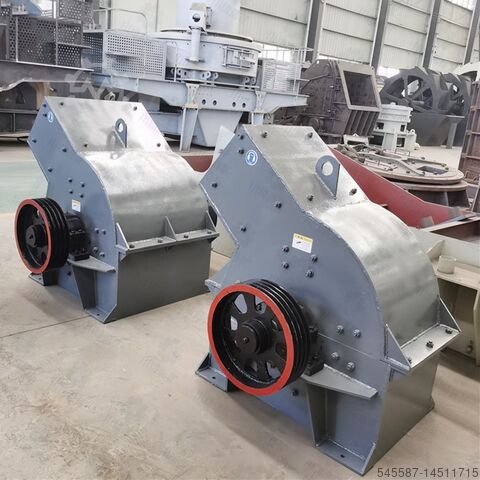
Hammer crusher /Hammer milllimestone, coal gangue,concrete crusher
Call
Condition: new, power: 55 kW (74.78 HP), Year of construction: 2026, A hammer crusher is a machine that uses high-speed rotating hammers to crush and break materials into smaller pieces. It is commonly used in various industries, including mining, cement, construction, metallurgy, and chemical processing. The basic principle of a hammer crusher involves a central rotor with hammers or blades that rotate and impact the material being crushed against a hard surface.
Here are the key features and components of a typical hammer crusher:
1. Rotor:
- The rotor is a central component of the hammer crusher. It usually consists of a shaft with multiple discs or hammers attached.
- The rotor's rotation causes the hammers to swing outward, impacting the material.
2. Hammers:
- Hammers are the striking or crushing elements attached to the rotor. They can be fixed or pivotally attached.
- The material is crushed as the hammers impact it, generating kinetic energy.
3. Casing or Housing:
- The casing or housing encloses the rotor and hammers, providing structural support and safety.
- It also serves to contain the crushed material and direct it to the desired discharge point.
4. Grate Bars or Screens:
- Positioned at the bottom of the crusher casing, grate bars or screens control the size of the crushed material by allowing smaller particles to pass through while keeping larger ones inside for further crushing.
5. Impact Plate:
- Located near the bottom of the crusher, the impact plate absorbs the impact energy generated by the hammers and prevents excessive wear on the casing.
6. Drive System:
- The hammer crusher is powered by a motor connected to the rotor through a drive belt or coupling.
- The motor provides the necessary power to rotate the rotor, enabling the hammers to crush the material.
7. Adjustable Discharge:
- Some hammer crushers feature an adjustable discharge, allowing users to control the size of the crushed material by adjusting the gap between the impact plate and the hammers.
8. Applications:
- Hammer crushers are used for crushing a variety of materials, including coal, limestone, gypsum, aggregates, and various minerals.
- They are commonly employed in the mining industry for primary and secondary crushing of ore.
- In the cement industry, hammer crushers are used to crush limestone and other materials before they are mixed into the raw meal.
9. Maintenance and Safety:
- Regular maintenance is essential to ensure the efficient operation of a hammer crusher. This includes checking and replacing worn hammers, inspecting the rotor, and lubricating moving parts.
- Safety features, such as access doors and safety guards, are typically incorporated to prevent accidents during operation and maintenance.
Technical Specifications (Typical MINGYUAN Series)
Model Category,Max Feed Size,Capacity (t/h),Motor Power (kW),Rotor Speed (rpm)
Klodsq I Nxdspfx Ak Ejt
Small (PC-400), ≤100mm, 5 – 10, 11, "1,000"
Medium (PC-800),≤200mm, 20 – 50, 55, 750 – 900
Heavy (PC-1200),≤350mm, 80 – 110, 132 – 160, 600 – 750
Heavy Hammer,"≤1,200mm", "500 – 1,000+ ","400 – 1,000" ,Variable
Listing


 Zheng Zhou Shi
11,505 km
Mill / grinding mill
Batch Ball Mill, Silica grinding millQuartz ball mill, silica powder grinding
Call
Year of construction: 2026, condition: new, ceramic ball mill ,Batch ball mill ,also called ceramic ball mill ,it is used for fine grinding of feldspar,quartz,clay,ore and so on.The ceramic ball mill is mainly used for material mixing, grinding,uniform product fineness,and saving power.It can be dry or wet.The machine can use different liner types according to production needs to meet different needs.The fineness of the grinding operation is controlled by the grinding time
ceramic ball mill Working principle
when ball mill working,steel balls inside drum will rotate with the drum to some height,and then steel balls fall down with materials to reach the point of grinding.
Working Principle of Ceramic ball mill
ceramic ball mill ,Intermittent ball mill grinding operation is finished in the cylinder body. When the cylinder rotates, materials ascend to a certain height and then fall along a certain path due to the balls' gravity. Two forces are generated on the balls inside. One is the force on balls through tangent direction; the other is a opposite force in the contrast to the diameter of balls, as a result of the force generated when the balls slide down. These two forces will constitute a couple for the steel balls. The balls are squeezed between the cylinder and the adjacent steel balls, so the couple can make unequal-sized friction force. The balls will orbit along with the cylinder axis and then fall down, which can produce a strong impact force on the ores in the cylinder body and, as a result, the ores will be crushed. In conclusion, the ores in the cylinder body are mainly crushed by composite effect of peeling force, impact force and extrusion force.
Ceramic ball mill also named Intermittent ball mill which adopts the wet intermittent operation, is used for fine grinding and mixing the material such as feldspar, quartz, clay ceramic raw materials. The discharging and the mud size can through through 1000 sieve pore. This machine is high milling machinery, materials should be Broken in the fineness of the state into the grinding mill to get the highest efficiency and economic benefits.
The cement mill is key equipment for the grinding process of the cement clinker after the crushing process of it. It is mainly used in the cement silicate product industry. After long term design and manufacture of the cement mill, our company now has series of cement mill with various specifications to meet with different requirement from our customers.
Features of Cement Mill
Our company adopts suitable transmission methods according to different specifications. We have brim drive and center drive as transmission form. The cylinder adopts new type step lining to increase the grinding area. And it is easily repairable and changeable. The new designed separate-chambered structure adopts flexible lifting blade and fixed lifting blade and it is easily fixed and repaired.
Klodpfevzx Auex Ak Ejt
Technical Details
We have different models and options for different requirements, please contact us for more info.
Listing


 Zheng Zhou Shi
11,505 km
Glass grinding machine
Henan Mingyuan Ceramic /Silica Ball MillBatch ball mill for glass ceramic making
Call
Condition: new, Year of construction: 2026, power: 7.5 kW (10.20 HP), Batch ball mills find applications in various industries where the processing of materials in discrete batches is required. The versatility of batch ball mills makes them suitable for a range of applications. Here are some common batch ball mill applications:
1. Ceramics Industry:
- *Glaze Preparation:* Batch ball mills are extensively used in the ceramics industry for preparing glazes. Raw materials such as feldspar, quartz, and clay are ground with ceramic balls to achieve the desired particle size for glaze formulation.
2. Chemical Industry:
- *Material Grinding:* Batch ball mills are used for grinding and blending various chemical materials. This includes the production of pigments, dyes, and other specialty chemicals where precise particle size control is crucial.
3. Pharmaceuticals:
- *Drug Formulation:* In pharmaceutical manufacturing, batch ball mills are used for grinding and blending powders to create drug formulations. The controlled environment provided by these mills is essential for maintaining the integrity of pharmaceutical compounds.
4. Food Industry:
- *Ingredient Mixing:* Batch ball mills may find application in the food industry for mixing and grinding ingredients. This can include the production of food additives, flavorings, and other powdered or granular products.
5. Mining and Minerals Processing:
- *Ore Grinding:* Batch ball mills are used in mining and minerals processing for grinding minerals and ores. The controlled grinding helps in obtaining the desired particle size for subsequent processes, such as mineral separation or extraction.
Kedpfx Aeq I N H Nek Eolt
6. Paints and Coatings:
- *Pigment Dispersion:* In the paints and coatings industry, batch ball mills are employed for dispersing pigments into paint formulations. Achieving a uniform particle size is crucial for the quality and appearance of the final coating.
7. Building Materials:
- *Raw Material Grinding:* Batch ball mills are used in the preparation of raw materials for the production of building materials, such as cement and concrete. Grinding of materials like limestone and clay helps in obtaining the desired fineness for subsequent processes.
8. Electronic Materials:
- *Ceramic Powder Processing:* In the electronics industry, batch ball mills can be employed for processing ceramic powders used in the production of electronic components and insulating materials.
9. Research and Development:
- *Material Testing:* Batch ball mills are often used in research and development laboratories for testing and optimizing material formulations. They provide a controlled environment for small-scale processing and experimentation.
10. Customized Applications:
- *Specialized Processes:* Batch ball mills can be adapted for various specialized processes in different industries where precise grinding and mixing are required. Custom modifications can be made based on specific application requirements.
When using a batch ball mill, it's important to consider factors such as the type of material being processed, desired particle size, and the specific requirements of the end product. Additionally, following the manufacturer's guidelines and maintaining proper operating conditions are essential for efficient and effective milling processes.
Technical details
We have different options for different requirements, please contact our team for more info.
Listing


 Zheng Zhou Shi
11,505 km
Cement mill,clinker grinding plant
Clinker grinding mill / cement ball millcement grinding with air classifier
Call
Year of construction: 2026, condition: new, functionality: fully functional, A cement clinker grinding mill is a specialized equipment used to grind the hard nodular clinker into fine powder, which is cement. Most cement is currently ground in ball mills and also vertical roller mills, which are more effective than ball mills.
Here are key features and information about cement clinker grinding mills:
1. Raw Materials:
- The main raw material for making cement is clinker, which is produced by sintering limestone and clay. Other materials such as gypsum, fly ash, or slag may also be added during the grinding process to achieve specific properties.
2. Grinding Process:
- The clinker and other additives are finely ground in the grinding mill to produce cement. The grinding process is a crucial step in cement production and contributes significantly to the final quality of the product.
3. Types of Mills:
- Ball Mills: Traditional ball mills are commonly used for grinding clinker. They operate by rotating a cylinder with steel grinding balls, causing the balls to fall back into the cylinder and onto the material to be ground.
- Vertical Roller Mills (VRM): VRM technology has become increasingly popular for clinker grinding. These mills use a rotating table with rollers to crush and grind the clinker, providing energy efficiency and a smaller footprint compared to ball mills.
4. Gypsum Addition:
- Gypsum is often added during the grinding process to control the setting time of the cement. It prevents flash setting of the clinker and facilitates the formation of a workable and pumpable cement paste.
5. Quality Control:
- Quality control measures, such as monitoring the fineness of the cement, chemical composition, and other properties, are implemented during the grinding process to ensure the final product meets the required specifications and standards.
6. Clinker Cooling:
- Before grinding, the clinker is produced by heating the raw materials in a kiln. The clinker is then cooled before entering the grinding mill to prevent excessive heat build-up during grinding.
7. Dust Collection and Environmental Considerations:
- Dust collectors and air pollution control systems are often employed to capture and control the dust generated during the grinding process, addressing environmental and safety concerns.
8. Packaging and Storage:
Kledpfjq Nfbhsx Ak Est
- After grinding, the cement is typically stored in silos before being packaged in bags or dispatched in bulk for distribution to construction sites or for sale in the market.
Cement clinker grinding mills play a crucial role in the cement production process, and advancements in technology continue to improve the efficiency and environmental sustainability of the grinding process.
Technical details
We have different options for different requirements, please contact our team for more info.
Listing


 Zheng Zhou Shi
11,505 km
Powder grinding mill
ball mill for mining &fine powder makingsilica/Barite/limestone powder plant
Call
Condition: new, Year of construction: 2026, power: 300 kW (407.89 HP), Ball Mill for Mining & Fine Powder Making:
A ball mill is a fundamental grinding device widely used in mining, metallurgy, cement, and chemical industries. It is designed to grind ores and other materials into fine powder through impact and attrition between steel balls and the material inside a rotating cylindrical shell. In mining plants, ball mills are essential for ore beneficiation, while in powder-making industries, they ensure uniform particle size and high surface area for further processing.
Working Principle
The ball mill operates on the principle of impact and friction. As the cylindrical shell rotates around its horizontal axis, the grinding media—usually steel or ceramic balls—are lifted along the inner wall by centrifugal force and friction. When they reach a certain height, they fall freely, striking and grinding the material below. This repeated motion breaks down the material into fine particles. The process can be carried out in dry or wet conditions depending on the application.
Structural Composition
A standard ball mill consists of several main components:
Feeding part: Ensures uniform material input through a feeder or screw conveyor.
Discharging part: Can be grate type or overflow type, depending on the discharge method.
Rotating part: The cylindrical shell made of steel plates, lined with wear-resistant liners.
Transmission system: Includes motor, reducer, small transmission gear, and electrical control.
Grinding media: Steel or ceramic balls of various diameters for efficient grinding.
The internal liner design and ball size distribution are optimized to achieve maximum grinding efficiency and minimal energy consumption.
Technical Details/Typical Specifications:
Feeding size: ≤25 mm
Discharge size: 0.074–0.4 mm
Capacity: 0.65–615 t/h (depending on model and material hardness)
Cylinder speed: 18–38 r/min
Power: 18.5–4500 kW
Liner material: High manganese steel, rubber, or alloy steel
Grinding media load: 30–45% of cylinder volume
Operating Modes:
Klsdpfjq Ngafsx Ak Eot
Dry grinding: Used for materials that must remain moisture-free, such as cement clinker, limestone, and quartz.
Wet grinding: Common in ore beneficiation, where water or slurry improves grinding efficiency and particle uniformity.
Application in Mining and Powder Production
In mining operations, ball mills are used after crushing to further reduce ore size and liberate valuable minerals. They are integrated into grinding circuits with classifiers, hydrocyclones, and flotation systems. The ground material is classified by size, and oversized particles are returned to the mill for regrinding. This closed-circuit system ensures consistent product fineness and efficient energy use.
In fine powder production, ball mills are used to produce materials such as silicate, ceramic powder, refractory materials, and chemical raw materials. The uniform particle size achieved by ball milling enhances product quality and performance in downstream applications.
Conclusion
A ball mill is an indispensable piece of equipment for both mining and fine powder making. Its ability to grind materials into fine, uniform particles makes it vital for ore beneficiation and industrial powder production. With flexible configurations, high efficiency, and reliable operation, modern ball mills provide a cost-effective and energy-efficient solution for large-scale grinding, ensuring consistent quality and productivity across diverse applications.

Trust Seal
Dealers certified through Used-Machines

Listing


 Zheng Zhou Shi
11,505 km
Roll forming line
Rod ball mill / Rod Grinding MillFor Sand and mining beneficiation plant
Call
Condition: new, Year of construction: 2026, We have various kinds of ball grinding mill such as batch ball mill, rod mill, cement ball mill, mining ball mill, welcome to contact our team for further details according to your specific requirements.
Kjdpfx Akoq I Nw Is Eslt
Listing


 Zheng Zhou Shi
11,505 km
Fine Powder Grinding Plant
Cement mill & Ultrafine Grinding MillFine Powder Grinding Plant
Call
Condition: new, functionality: fully functional, Year of construction: 2026, Cement Mill & Ultrafine Grinding Mill
🏗️ Introduction to Cement Mill & Ultrafine Grinding Mill
In the world of construction and materials processing, achieving the right particle size is essential. Introducing the Cement Mill and Ultrafine Grinding Mill—two pivotal machines designed to deliver superior grinding performance for cement production and ultrafine materials. Let’s dive into their features and applications! 💼
🔥 What is a Cement Mill?
A Cement Mill is a crucial piece of equipment in cement production. It grinds clinker, gypsum, and other additives to produce fine cement powder. This machine ensures the optimal particle size for high-quality cement, essential for building robust structures. 🚀
🔧 What is an Ultrafine Grinding Mill?
An Ultrafine Grinding Mill is designed to produce extremely fine powders from various raw materials, such as minerals, chemicals, and industrial waste. It operates at high efficiency, delivering ultra-fine materials for advanced applications like coatings, plastics, and ceramics. 🌟
💼 Key Benefits of Using Cement Mill & Ultrafine Grinding Mill
1. High Efficiency: Both mills are engineered for maximum efficiency, ensuring rapid processing times and reduced energy consumption. 🌿💡
2. Superior Grinding Performance: Achieve consistent, high-quality output with precise control over particle size. 🏭
3. Versatility: Suitable for a wide range of materials, making them essential for various industrial applications. 🌳
4. Durability and Reliability: Built with robust materials, these mills offer long-lasting performance in demanding industrial environments. 💪
Klsdpfx Aoq Nyydsk Ejt
📈 Applications in Industry
Cement Mill Applications:
1. Cement Production: Essential for producing high-quality cement for construction projects.
2. Infrastructure Development: Used in creating concrete for roads, bridges, and buildings.
Ultrafine Grinding Mill Applications:
1. Mineral Processing: Producing ultra-fine powders for advanced material applications.
2. Chemical Manufacturing: Used in creating fine chemicals for various industrial processes.
3. Environmental Applications: Grinding industrial waste for recycling and reuse. ♻️
🌟 Conclusion
Whether you’re in construction, materials processing, or advanced manufacturing, the Cement Mill and Ultrafine Grinding Mill are indispensable tools. Their efficiency, versatility, and superior performance make them a valuable addition to any production line. Contact us today to learn more about these innovative machines and how they can revolutionize your operations! 📞
Listing


 Zheng Zhou Shi
11,505 km
Ball Mill for Ore mining & sand grinding
batch ball mill & wet mining ball mill2400X4500 ball mill
Call
Condition: new, fuel type: electric, Year of construction: 2026, machine/vehicle number: 2700x4500, Equipment: low noise, Main Technical parameters of the ball mill
Drum diameter: 2400mm
Drum length: 4500mm
Motor power: 320KW
Max input size: 25mm
Capacity:35-60 t/h
Weight: 72Tons
Ball loading: 30Tons
Besides this model, we also have the other models like 2700x4500, 3200x4500, 1830x13000mm, and so on, and we can also offer customerization service, we can also provide complete grinding solution for various industries like cement, quartz, ore beneficiation plant, and so on, welcome to contact us for more info.
A ball mill is a common grinding machine used to grind and blend materials for use in mineral processing, including ore mining and the production of silica (silicon dioxide). When it comes to ore mining and silica grinding, the characteristics of the ore and the final product requirements will play a crucial role in selecting the appropriate ball mill.
Here are some considerations for using a ball mill in ore mining and silica grinding:
1. Ore Characteristics:
- Hardness: The hardness of the ore determines the type of ball mill that is most suitable. Harder ores may require a more robust and wear-resistant ball mill.
- Particle Size Distribution: The initial particle size of the ore affects the grinding process. Different ores may require different approaches to achieve the desired particle size.
2. Silica Grinding:
- Silica Content: If the primary goal is to grind silica, it's important to consider the initial silica content and the desired final particle size. Silica grinding often requires special attention to prevent excessive wear on the milling equipment.
3. Ball Mill Type:
- Overflow vs. Grate Discharge: The type of discharge from the ball mill can impact the final product and the grinding efficiency. Overflow mills are generally used for most grinding applications, while grate discharge mills are more suitable for certain types of ores.
4. Mill Size and Capacity:
- Mill Diameter and Length: The size of the ball mill should be selected based on the amount of material to be ground and the desired throughput.
- Capacity: Ensure that the chosen ball mill has the capacity to handle the required volume of material efficiently.
5. Grinding Media:
- Material and Size: The choice of grinding media (balls or cylpebs) and their size depends on the hardness of the ore and the desired final particle size. Different grinding media materials can impact the purity of silica during grinding.
6. Liners and Lifting Aids:
- Liners: Consider the type of liners used in the ball mill to protect the shell and optimize the grinding process.
Kedpfxsq Igiio Ak Eelt
- Lifting Aids: Some mills use lifting aids to enhance the grinding action and promote better mixing of the material.
7. Control and Monitoring Systems:
- Automation: Utilize control systems to automate the milling process and ensure optimal performance.
- Monitoring: Regularly monitor the milling process to adjust parameters as needed for consistent and efficient operation.
8. Safety Measures:
- Safety Systems: Implement safety features to protect personnel and equipment during operation.
Always follow the manufacturer's recommendations and guidelines for operation and maintenance to ensure safe and efficient use of the ball mill in ore mining and silica grinding applications.
Listing


 Zheng Zhou Shi
11,505 km
Powder grinding machine
Fine powder grinding mill, clinker millSuperfine ball mill for micro powder
Call
Condition: new, Year of construction: 2026, A superfine ball mill is a type of milling machine that is used to grind materials into very fine particles. This type of ball mill has some distinctive features that make it especially suitable for processing even the hardest materials with low contamination and minimal wear. It is commonly used in various industries, including pharmaceuticals, minerals, pigments, and chemicals, for producing micro powder or nanoparticles.
Here are some key features and considerations for a superfine ball mill for micro powder:
1. High Grinding Efficiency: Superfine ball mills are designed to achieve high grinding efficiency by utilizing grinding media with a relatively small size, leading to a large surface area for grinding.
2. Precision Control: These mills often come with advanced control systems to regulate parameters like rotation speed, temperature, and grinding time, allowing precise control over the particle size distribution.
3. Specialized Design: The mill is typically designed with features to minimize contamination, such as using materials resistant to wear and corrosion. Some mills also have cooling systems to prevent overheating during the milling process.
4. Variety of Materials: Superfine ball mills can handle a wide range of materials, including both brittle and fibrous substances. They are often used for milling hard materials that require fine grinding, such as ceramics, minerals, or pigments.
5. Size Reduction to Micro or Nano Level: The primary goal of a superfine ball mill is to reduce particle size to the micro or even nano level. This is achieved by the intense grinding action that occurs within the mill.
6. Classifier System: Some superfine ball mills incorporate a classifier system to control the particle size distribution more precisely. This allows for the separation of fine particles from coarser ones during the milling process.
Kedpfx Akjq Nf Uwe Eelt
7. Batch or Continuous Operation: Depending on the specific design, these mills can operate in either batch or continuous mode, offering flexibility based on the production requirements.
8. Safety Measures: Safety features may be included, such as monitoring and control systems to prevent overloading, overheating, or other potential issues during operation.
When selecting a superfine ball mill for micro powder production, it's important to consider the specific requirements of your application, the characteristics of the materials you're working with, and the desired final particle size distribution. Always follow the manufacturer's guidelines for operation, maintenance, and safety to ensure optimal performance and longevity of the equipment.
We make it easier for you to find: "bachiller jet-mill msb305"
You will receive new offers immediately and free of charge via e-mail
You can easily terminate the search request at any time

Get information now
+49 201 857 86 122
+49 201 857 86 122
List now
*per listing / month


