


Used Fabo Jaw Crusher Crushing Equipment / Jaw Crusher for sale (43,157)
Sort results
- Lowest price Highest price
- Newest listings Oldest listings
- Shortest distance Farthest distance
- Newest year of manufacture Oldest year of manufacture
- Latest update Oldest update
- Manufacturer A to Z Manufacturer Z to A
- Relevance
- Lowest price
- Price
- Highest price
- Price
- Newest listings
- Release date
- Oldest listings
- Release date
- Shortest distance
- Distance
- Farthest distance
- Distance
- Newest year of manufacture
- Year of construction
- Oldest year of manufacture
- Year of construction
- Latest update
- Update
- Oldest update
- Update
- Manufacturer A to Z
- Manufacturer
- Manufacturer Z to A
- Manufacturer
- designation from A to Z
- Description
- designation from Z to A
- Description
- Model from A to Z
- Model
- Model from Z to A
- Model
- Lowest reference
- Ref.No.
- Highest reference
- Ref.No.
- Shortest runtime
- Runtime
- Longest duration
- Runtime
- Relevance
- Relevance
Listing


 Turkey
9,817 km
Crushing equipment
Mobile Limestone Crusher PlantGNR 03
Call
Condition: new, functionality: fully functional, power: 250 kW (339.91 HP), fuel type: electric, color: dark red, Year of construction: 2026, GNR 03 Mobile Lime Stone Crusher and Screening Plant has a capacity of 250 / 350 TPH.
It can easily break stones of different hardness.
Complies with international shipping standards.
Installation and commissioning is done in a short time.
Local workers (staff) are taught how to control.
Lifetime spare parts support is provided.
OPTIONAL
- By-pass system
- Magnetic magnet
- Generator System
- Dust Removal System
- Frequency Control System is used instead of soft starter
- Control cabin and air conditioning
Dodpfx Acjwnqfgomjck
Please call us for our other crushing plants and customized solutions.
Listing


 Turkey
9,817 km
Crushing equipment
General MakinaBauxite Crushing and Screening Plant
Call
Condition: new, functionality: fully functional, Year of construction: 2026, Bauxite Crushing and Screening Plant with a Capacity of 250-450 Tons/Hour
Dcsdpoxqx Hnefx Acmsk
Designed for stationary bauxite ore crushing and screening, this plant's primary equipment consists of a
primary jaw crusher and a secondary jaw crusher.
It produces an average of 250-450 tons of crushed bauxite per hour.
This plant, shown as an example, operates in Türkiye.
General Makina offers stationary stone crushing and screening plants that you can customize to your needs.
Listing


 Turkey
9,817 km
Crushing equipment
General MakinaGranite & Basalt Crushing and Screening
Call
Condition: new, functionality: fully functional, Year of construction: 2026, This is a specialized plant designed to crush hard and abrasive basalt and granite, with a capacity of 250-300 tons per hour.
Its primary equipment includes jaw crushers, cone crushers, and vertical shaft impact crushers.
Dcjdpfxoxqycws Acmek
This example facility operates in Romania.
At General Makina, we design and manufacture stone crushing, screening, and washing plants specifically for your investment projects, and we provide worldwide shipping.
Contact us for more information.
Listing


 Turkey
9,817 km
Crushing equipment
General MakinaDolomite Crushing and Screening Plant
Call
Condition: new, functionality: fully functional, Year of construction: 2026, This facility, which we manufacture for the crushing and screening of dolomite at a capacity of 250 to 300 tons per hour,
includes the following equipment: Jaw Crushers, VSI Vertical Shaft Crushers, Secondary Impact Crushers, and Tertiary Crushers.
Contact us now to purchase this example plant or a new crushing and screening plant that we can customize to your specifications.
Dcsdpfx Ajxqx Niocmok
Listing


 Zheng Zhou Shi
11,505 km
Crushing equipment
Symons cone crusher/mobile crusherSpring cone crusher PYB900, PYD900

Call
Condition: new, Year of construction: 2026, Cone Crusher: Types, Features, and Applications
Cone crushers are essential equipment in the mining, construction, and aggregate industries. They are designed to crush hard and medium-hard materials such as granite, basalt, iron ore, and limestone into smaller, uniform sizes. This article explores the different types of cone crushers, including spring cone crushers, compound cone crushers, and Symons cone crushers, and provides insights into choosing the right cone crusher for sale.
What Is a Cone Crusher?
A cone crusher is a compression-type machine that reduces material size by squeezing it between a moving piece of steel (the mantle) and a stationary piece (the concave). The material is crushed as it moves downward through the chamber, achieving fine and uniform output. Cone crushers are widely used in secondary, tertiary, and fine crushing stages.
Spring Cone Crusher
The spring cone crusher is one of the earliest and most traditional types of cone crushers. It uses a spring system to protect the crusher from damage when uncrushable materials enter the chamber. Key features include:
Reliable structure and low maintenance
Adjustable discharge size for different crushing requirements
Overload protection through the spring safety system
Suitable for medium and fine crushing of various ores and rocks
Spring cone crushers are ideal for small to medium-scale operations that require stable performance and cost efficiency.
Compound Cone Crusher
The compound cone crusher, also known as the combination cone crusher, integrates the advantages of both spring and hydraulic cone crushers. It features a robust design and high crushing efficiency. Main characteristics include:
High crushing ratio and uniform product size
Hydraulic cleaning system for easy maintenance
Strong adaptability to different materials and production conditions
Energy-efficient operation
This type of cone crusher is widely used in mining, metallurgy, construction, and chemical industries, offering a balance between performance and affordability.
Symons Cone Crusher
The Symons cone crusher is a classic model that has been used for decades in the mining and aggregate industries. It is known for its simple structure, reliable performance, and high productivity. Key advantages include:
Stable operation and long service life
Uniform particle size distribution
Easy adjustment of the discharge opening
Low operating cost
Symons cone crushers are available in several models, including 3ft, 4ft, 4¼ft, 5½ft, and 7ft, to meet different capacity requirements.
Cone Crusher for Sale
When selecting a cone crusher for sale, several factors should be considered:
Material hardness and abrasiveness – Choose a crusher designed for the specific material type.
Production capacity – Match the crusher size and power to the required output.
Automation and control systems – Modern cone crushers offer hydraulic and PLC systems for easier operation.
Dodpoq Nd Ndofx Acmeck
After-sales service and spare parts availability – Reliable support ensures long-term performance.
Henan Mingyuan Heavy Industrial Equipment Co., LTD offers a wide range of cone crushers, including spring, compound, and Symons models. Each machine is built with high-quality materials and advanced technology to ensure efficient and durable performance.
Listing


 Zheng Zhou Shi
11,505 km
Crushing equipment
MINGYUAN Double rotor hammer crusherDouble stage hammer crusher
Call
Condition: new, power: 90 kW (122.37 HP), Year of construction: 2026, A double rotor hammer crusher is a type of crusher in which two rotors are mounted on a single shaft, combined to form a spinning rotor. The double rotor arrangement enhances the crushing capabilities and provides a more efficient and reliable crusher design compared to single rotor crushers.
Here are some key features and aspects of a double rotor hammer crusher:
1. Two Rotors: As the name suggests, the crusher has two rotors that rotate in opposite directions on a common shaft. This dual rotor configuration allows for increased impact and crushing power.
2. High Capacity: The dual rotor design enables the crusher to handle larger feed sizes and higher capacity compared to single rotor crushers. It is suitable for crushing materials with high hardness and large sizes.
3. Versatility: Double rotor hammer crushers are versatile and can be used in various applications, including the reduction of limestone, gypsum, coal, and other similar materials in the mining, cement, and building materials industries.
4. Impact Crushing: The primary mechanism of crushing in a double rotor hammer crusher is through the impact of the hammers against the material. The material is fed into the crusher, and the high-speed rotating hammers impact and shatter the particles.
5. Adjustable Gap Settings: These crushers often have adjustable gap settings between the rotors and the impact bars, allowing control over the final particle size.
6. Durability: The robust design of the double rotor hammer crusher makes it durable and capable of handling tough materials and continuous operation.
7. Reduced Wear: The dual rotor arrangement can help distribute wear more evenly across the hammers and other wear parts, potentially extending the overall lifespan of the crusher.
Typical Technical Specifications
While exact numbers vary by manufacturer, these are the standard ranges for industrial models:
Model (Rotor Size),Max Feed Size,Output Size,Capacity (t/h),Total Motor Power
Djdpfx Aeq Nf Enecmeck
600 × 400,≤110 mm,≤3 mm,10 – 15,18.5+18.5 kW
800 × 600,≤120 mm,≤3 mm,40 – 50,45+45 kW
800 × 800,≤180 mm,≤3 mm,50 – 60,45+55 kW
1000 × 800,≤180 mm,≤3 mm,70 – 80,75+55 kW
1100 × 1000,≤200 mm,≤3 mm,70 – 100,90+110 kW
1400 × 1200,≤200 mm,≤3 mm,90 – 110,132+160 kW
For more details about double stage hammer crusher, or double rotor crusher, welcome to leave us a message, our team will get back to you at the earlist.
Listing


 Zheng Zhou Shi
11,505 km
Crushing equipment
Stone crushing production lineStone crushing screening plant
Call
Condition: new, functionality: fully functional, Year of construction: 2026, A stone crushing plant for sand and aggregate making is a facility where stones and rocks are crushed into smaller pieces or gravel. It typically includes several stages of crushing and screening to produce various sizes and grades of sand and aggregate materials, which are essential in construction, landscaping, and other applications. Here's an introduction to the components and processes involved in a typical stone crushing plant:
### Components of a Stone Crushing Plant
1. Primary Crusher:
- Purpose: The primary crusher, often a jaw crusher or gyratory crusher, initially breaks down large rocks into smaller pieces.
- Function: It handles raw materials from the quarry or mine and prepares them for further processing.
2. Secondary Crusher:
- Purpose: A secondary crusher, such as a cone crusher or impact crusher, further reduces the size of the crushed stones.
- Function: It refines the material after primary crushing, producing smaller and more uniform-sized aggregates.
3. Tertiary Crusher (Optional):
- Purpose: In some configurations, a tertiary crusher like a vertical shaft impactor (VSI) may be used for shaping and fine crushing.
- Function: It produces finely crushed materials for specific applications, such as concrete production or road base.
4. Screening Equipment:
- Purpose: Screening equipment like vibrating screens or trommel screens separates the crushed materials into different sizes.
- Function: It classifies the aggregates into various grades according to size, ensuring uniformity and meeting specifications.
5. Conveyor Systems:
- Purpose: Conveyor belts transport materials between different stages of crushing and screening.
- Function: They ensure efficient material handling and continuous operation within the plant.
6. Washing Equipment (Optional):
- Purpose: Washing equipment, such as sand washers or scrubbers, may be used to remove impurities from sand and aggregate products.
- Function: It improves the quality of the final products by cleaning them and removing fines or contaminants.
### Processes Involved
- Primary Crushing: Large rocks are fed into the primary crusher and reduced to a manageable size.
- Secondary Crushing: The crushed materials from the primary crusher are further processed by secondary crushers to achieve the desired aggregate sizes.
- Screening: The crushed and sized materials are screened to separate them into different sizes and grades.
Dcjdpsq N U Duofx Acmjk
- Material Handling: Conveyor systems transport materials between different stages of the crushing and screening process.
Final Product Handling:Finished products, such as sand and various sizes of aggregates, are stored or loaded for transport to customers or construction sites.
Applications
- Construction: Used in the production of concrete, asphalt, and road base materials.
- Landscaping: Provides decorative and functional aggregates for gardens, pathways, and driveways.
infrastructure: Essential for building foundations, drainage systems, and structural fill.
As for the capacity we have 30 t/h, 30-50 t/h, 50-100 t/h, 100-150 t/h, 150-200 t/h, 200-300 t/h, 300-500 t/h, and both stationary crushing plant and mobile crushing plant are available for option.
Listing


 Zheng Zhou Shi
11,505 km
Crushing equipment
Mingyuan Dry and Wet Ball MillCustomerizable Model for ball mill plant
Call
Condition: new, functionality: fully functional, Year of construction: 2026, Dry and Wet Ball Mill: Structure, Operation, and Technical Details
A ball mill is a fundamental grinding device used in mineral processing, cement manufacturing, chemical production, and other industrial applications. It works by rotating a cylindrical shell filled with grinding media—usually steel balls—causing impact and friction that reduce materials to fine powder. Based on the grinding environment, ball mills are classified into dry and wet types, each suited for specific materials and process requirements.
Working Principle
Both dry and wet ball mills operate on the same mechanical principle. The rotating cylinder, driven by a motor through a gear system, lifts the grinding media and material along the inner wall. As the rotation continues, the balls fall under gravity, striking and grinding the material. The difference lies in the presence or absence of a liquid medium during grinding.
Dry Ball Mill
A dry ball mill is used when the material must remain moisture-free or when water could affect product quality. It is commonly applied in cement clinker, limestone, quartz, and refractory material grinding. The discharge can be either grate type or overflow type, depending on the desired fineness.
Technical Features:
Feeding size: ≤25 mm
Dcsdpfx Asq Nx Alscmek
Discharge size: 0.075–0.4 mm
Capacity: 0.65–90 t/h
Liner material: High manganese steel or wear-resistant alloy
Drive system: Gear-driven or direct-coupled motor
Dust control: Equipped with air exhaust and dust collector
Advantages:
Suitable for materials sensitive to moisture
No drying process required after grinding
Lower corrosion risk and simpler maintenance
Easier material classification and separation
Limitations:
Dry grinding produces more dust and heat, requiring efficient ventilation and dust collection systems.
Wet Ball Mill
A wet ball mill operates with water or another liquid medium added to the material. The slurry formed during grinding improves efficiency by reducing friction and preventing excessive heat buildup. It is widely used in ore beneficiation, ceramics, and chemical industries.
Technical Features:
Feeding size: ≤25 mm
Discharge size: 0.074–0.2 mm
Capacity: 0.65–615 t/h
Liner material: Rubber or high-chromium steel
Discharge method: Overflow or grate type
Auxiliary equipment: Classifier, pump, and thickener for slurry circulation
Advantages:
Higher grinding efficiency and finer particle size
Reduced dust and noise levels
Continuous operation suitable for beneficiation circuits
Better control of particle uniformity
Limitations:
Requires drying if the final product must be in powder form and involves more complex slurry handling.
The selection between dry and wet grinding depends on the material characteristics, downstream process, and environmental conditions. Dry mills are preferred for materials that must stay moisture-free, while wet mills are ideal for fine grinding and slurry-based processes.
Conclusion
Dry and wet ball mills share the same mechanical structure but differ in their grinding environment and application scope. The dry type offers simplicity and low maintenance for moisture-sensitive materials, while the wet type provides higher efficiency and finer output for mineral and chemical processing. Understanding their technical parameters and operational differences ensures optimal equipment selection, improved productivity, and reliable performance in industrial grinding operations.
Listing


 Zheng Zhou Shi
11,505 km
Crushing equipment
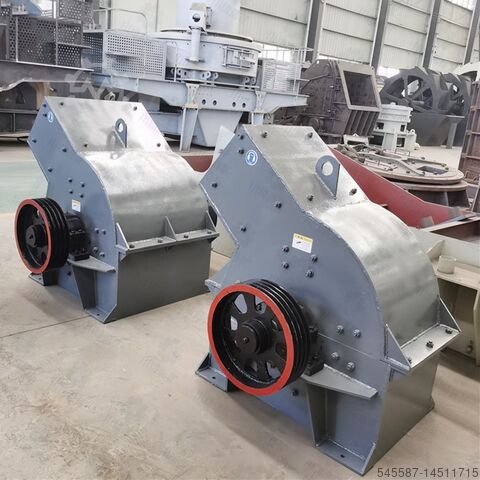
Hammer crusher /Hammer milllimestone, coal gangue,concrete crusher
Call
Condition: new, power: 55 kW (74.78 HP), Year of construction: 2026, A hammer crusher is a machine that uses high-speed rotating hammers to crush and break materials into smaller pieces. It is commonly used in various industries, including mining, cement, construction, metallurgy, and chemical processing. The basic principle of a hammer crusher involves a central rotor with hammers or blades that rotate and impact the material being crushed against a hard surface.
Here are the key features and components of a typical hammer crusher:
1. Rotor:
- The rotor is a central component of the hammer crusher. It usually consists of a shaft with multiple discs or hammers attached.
- The rotor's rotation causes the hammers to swing outward, impacting the material.
2. Hammers:
- Hammers are the striking or crushing elements attached to the rotor. They can be fixed or pivotally attached.
- The material is crushed as the hammers impact it, generating kinetic energy.
3. Casing or Housing:
- The casing or housing encloses the rotor and hammers, providing structural support and safety.
- It also serves to contain the crushed material and direct it to the desired discharge point.
Dcsdpfxoq I Nxds Acmsk
4. Grate Bars or Screens:
- Positioned at the bottom of the crusher casing, grate bars or screens control the size of the crushed material by allowing smaller particles to pass through while keeping larger ones inside for further crushing.
5. Impact Plate:
- Located near the bottom of the crusher, the impact plate absorbs the impact energy generated by the hammers and prevents excessive wear on the casing.
6. Drive System:
- The hammer crusher is powered by a motor connected to the rotor through a drive belt or coupling.
- The motor provides the necessary power to rotate the rotor, enabling the hammers to crush the material.
7. Adjustable Discharge:
- Some hammer crushers feature an adjustable discharge, allowing users to control the size of the crushed material by adjusting the gap between the impact plate and the hammers.
8. Applications:
- Hammer crushers are used for crushing a variety of materials, including coal, limestone, gypsum, aggregates, and various minerals.
- They are commonly employed in the mining industry for primary and secondary crushing of ore.
- In the cement industry, hammer crushers are used to crush limestone and other materials before they are mixed into the raw meal.
9. Maintenance and Safety:
- Regular maintenance is essential to ensure the efficient operation of a hammer crusher. This includes checking and replacing worn hammers, inspecting the rotor, and lubricating moving parts.
- Safety features, such as access doors and safety guards, are typically incorporated to prevent accidents during operation and maintenance.
Technical Specifications (Typical MINGYUAN Series)
Model Category,Max Feed Size,Capacity (t/h),Motor Power (kW),Rotor Speed (rpm)
Small (PC-400), ≤100mm, 5 – 10, 11, "1,000"
Medium (PC-800),≤200mm, 20 – 50, 55, 750 – 900
Heavy (PC-1200),≤350mm, 80 – 110, 132 – 160, 600 – 750
Heavy Hammer,"≤1,200mm", "500 – 1,000+ ","400 – 1,000" ,Variable
Listing


 Zheng Zhou Shi
11,505 km
Crushing equipment
Spring & Hydraulic cone crusherSpring & Compound&Hydraulic cone crusher
Call
Condition: new, functionality: fully functional, fuel type: electric, Year of construction: 2026, Spring & Hydraulic Cone Crusher: Design, Operation, and Technical Insights
Cone crushers are vital in mining, metallurgy, and aggregate production, designed for secondary and tertiary crushing of hard and medium-hard materials. Among the most common types are the spring cone crusher and the hydraulic cone crusher, each offering distinct advantages in structure, performance, and control.
Spring Cone Crusher
The spring cone crusher is a traditional design that uses mechanical spring systems for overload protection. When uncrushable material enters the crushing chamber, the spring mechanism allows the bowl liner to move downward, preventing damage to the crusher. Once the foreign object passes, the springs restore the original position, ensuring continuous operation.
Structural Composition:
Main frame and base assembly
Eccentric shaft and transmission system
Dodpfxotxhybs Acmjck
Fixed and moving cones (mantle and concave)
Spring and adjustment mechanism
Working Principle:
Material is fed into the crushing chamber and compressed between the mantle and concave. The laminated crushing principle ensures that particles are crushed by both impact and pressure, producing uniform and well-shaped aggregates.
Technical Highlights:
Feed size: ≤300 mm
Discharge size: 3–60 mm
Capacity: 30–700 t/h
Motor power: 75–400 kW
Advantages: Simple structure, low maintenance cost, stable performance, and reliable overload protection.
Applications:
Widely used in crushing granite, basalt, iron ore, copper ore, and limestone. It is suitable for medium-scale operations where cost efficiency and durability are priorities.
Hydraulic Cone Crusher
The hydraulic cone crusher is an advanced evolution of the spring design, integrating hydraulic systems for improved automation, safety, and precision. It replaces the mechanical spring system with hydraulic cylinders that control the discharge opening and provide overload protection.
Structural Composition:
Main frame and eccentric assembly
Hydraulic cylinders and control system
Crushing chamber with optimized liner design
Automatic lubrication and hydraulic adjustment units
Working Principle:
The hydraulic system adjusts the discharge opening and releases pressure automatically when uncrushable material enters. This prevents mechanical damage and allows the crusher to resume operation quickly. The combination of high-speed eccentric motion and optimized chamber geometry enhances crushing efficiency and product quality.
Technical Highlights:
Feed size: ≤320 mm
Discharge size: 3–50 mm
Capacity: 45–1200 t/h
Motor power: 90–630 kW
Advantages: Automatic cavity cleaning, precise control, high crushing ratio, and superior particle shape.
Applications:
Ideal for large-scale mining, aggregate production, and high-demand crushing lines requiring consistent output and minimal downtime.
Comparative Overview
Both crushers operate on the same compression principle but differ in control and automation. The spring cone crusher offers simplicity and cost-effectiveness, making it suitable for stable working conditions. The hydraulic cone crusher provides advanced control, faster adjustment, and higher efficiency, ideal for modern, large-capacity plants.
Listing


 Zheng Zhou Shi
11,505 km
Crushing equipment
Single & Multi-Cylinder cone crusherMultiple cylinder hydraulic cone crusher
Call
Condition: new, power: 250 kW (339.91 HP), Year of construction: 2025, The Multiple Cylinder Hydraulic Cone Crusher is an advanced type of cone crusher designed to provide higher productivity and better crushing performance than traditional single-cylinder cone crushers. Here are some key features and information about multiple cylinder hydraulic cone crushers:
1. Structure and Working Principle:
- Multiple cylinder hydraulic cone crushers typically have three or more cylinders.
- The crushing chamber is formed between the mantle (outer fixed cone) and the concave (inner moving cone).
- The cylinders control the movement of the inner cone, providing a highly efficient and uniform crushing process.
2. Hydraulic System:
- Each cylinder is equipped with its hydraulic system, allowing for independent control of the crushing chamber.
- The hydraulic system is used for adjusting the discharge opening size, controlling the tramp iron release, and providing overload protection.
3. Adjustable Discharge Opening:
- The discharge opening can be easily adjusted to control the size of the crushed product.
4. Automation and Control System:
- Multiple cylinder hydraulic cone crushers often feature advanced automation and control systems.
Dcjdpfoq Nd Rbex Acmek
- These systems can include programmable logic controllers (PLCs) and human-machine interfaces (HMIs) for convenient operation and monitoring.
5. Application:
- Multiple cylinder hydraulic cone crushers are suitable for crushing hard and medium-hard materials in industries such as mining, metallurgy, building materials, and road construction.
- They are particularly effective for crushing materials with high hardness and abrasive index.
6. Advantages:
- Higher crushing efficiency and throughput compared to single-cylinder cone crushers.
- Better shape of the crushed product due to the uniform crushing action.
- Improved reliability and maintenance convenience.
- Enhanced safety features with the hydraulic system providing overload protection.
7. Disadvantages:
- Potentially higher initial cost compared to single-cylinder cone crushers.
- May require more complex maintenance and repairs.
8. Models and Specifications:
- Multiple cylinder hydraulic cone crushers come in various models, such as HPT series, HP series, and others, each with different specifications.
9. Manufacturers:
- Various manufacturers produce multiple cylinder hydraulic cone crushers. Well-known manufacturers often provide reliable and high-quality equipment.
When considering a multiple cylinder hydraulic cone crusher, it's essential to assess your specific needs, compare features of different models, and consider factors such as capacity, feed size, and required end product specifications. Additionally, check the reputation and customer feedback regarding the manufacturer and model you are interested in.
Listing


 Zheng Zhou Shi
11,505 km
Crushing equipment
Mobile / Stationary Rock Crushing Plant50-400 t/h stone crushing plant
Call
Condition: new, functionality: fully functional, Year of construction: 2025, For crushing dolomite and phonolite rocks, various types of rock crushing machines can be employed, depending on the characteristics of the rocks and the desired final product specifications. Here are some common types of crushers that may be suitable for processing dolomite and phonolite:
1. Jaw Crusher:
- Jaw crushers are commonly used for primary crushing and can handle hard and abrasive materials. They are suitable for both dolomite and phonolite rocks.
2. Impact Crusher:
- Impact crushers are versatile and suitable for both primary and secondary crushing. They work by impacting the material with hammers or blow bars, producing a high reduction ratio. Impact crushers can be effective for shaping the final product.
Dcedpfx Aeq Nyuvjcmek
3. Cone Crusher:
- Cone crushers are often used for secondary or tertiary crushing. They are suitable for processing harder rocks and can produce well-shaped and fine-grained aggregates.
4. Gyratory Crusher:
- Gyratory crushers are used for large-scale primary crushing. They have a conical-shaped head and are well-suited for handling abrasive materials. However, they are less commonly used than jaw or cone crushers.
5. Vertical Shaft Impact (VSI) Crusher:
- VSI crushers are suitable for shaping and producing artificial sand. They operate by throwing the material against a set of anvils or impellers to break it down into finer particles.
6. Hammer Crusher:
- Hammer crushers are used for crushing softer materials and may be suitable for rocks like phonolite. They operate by applying force to the material, causing it to break along natural fault lines.
7. Roll Crusher:
- Roll crushers are used for reducing the size of friable materials. They consist of two counter-rotating rolls that compress the material between them.
8. Screening Equipment:
- After the initial crushing stage, screening equipment such as vibrating screens may be used to separate different sizes of crushed material.
9. Dust Suppression Systems:
- Crushing operations can generate dust, and dust suppression systems are used to minimize environmental and health impacts.
10. Mobile Crushers:
- Mobile crushers, including crawler mobile crushers, offer flexibility and mobility, allowing them to be used directly at the quarry or job site.
When selecting a crusher for dolomite and phonolite rocks, consider factors such as the hardness of the material, the desired final product specifications, and the production capacity required. Additionally, it's important to integrate the crushing process into an overall plant design that may include screening, conveying, and washing equipment depending on the specific needs of the application.
Listing


 Zheng Zhou Shi
11,505 km
Crushing equipment
VSI Sand maker / Sand making machineVertical Shaft Impact Crusher for sand
Call
Condition: new, functionality: fully functional, Year of construction: 2025, The VSI (Vertical Shaft Impactor) sand making machine is a type of crusher designed to accelerate the crushing of aggregate and produce cubical-shaped sand. It is widely used in the field of construction, mining, and other similar industries. Here are key features and information about VSI sand making machines:
1. Working Principle:
- The VSI sand making machine operates on the principle of stone impacting stone or stone impacting iron. Material is fed into the center of the rotor, which accelerates to high speed to throw the material outward against a wear-resistant lining.
2. Rotor and Crushing Chamber:
- The rotor is a crucial part of the VSI machine and is often designed with multiple pockets to facilitate material throwing and crushing.
- The crushing chamber is lined with wear-resistant materials to endure the impact and abrasion during the crushing process.
3. Feedstock Control:
- The feedstock (material to be crushed) can be controlled using a variable speed control system, allowing for adjustments to achieve the desired particle size.
4. Material Types:
- VSI machines are suitable for processing various materials, including hard and abrasive materials such as rocks, ores, and minerals.
5. Cubical Shaping:
- One of the significant advantages of VSI machines is their ability to produce cubical-shaped end products, which is desirable for high-quality concrete and asphalt production.
6. Adjustable Discharge:
- The machine usually has an adjustable discharge opening, allowing for customization of the final product size.
7. Sand Production:
- VSI sand making machines are primarily used to produce manufactured sand (M-sand) and crushed sand, which are essential components in the construction industry.
8. Maintenance:
- Regular maintenance is required to ensure optimal performance and extend the machine's lifespan. This includes checking wear parts, lubrication, and addressing any issues promptly.
9. Variations:
- Different manufacturers may offer variations of VSI machines with unique features or specifications. Common variations include open rotor and closed rotor designs.
10. Environmental Considerations:
Dcsdpoq Nd U Hjfx Acmok
- VSI sand making machines are generally considered environmentally friendly as they produce less dust and noise compared to traditional crushers.
11. Manufacturers:
- Well-known manufacturers produce VSI sand making machines, and it's crucial to choose a reputable supplier with a track record of providing reliable equipment.
When considering a VSI sand making machine, factors such as feed size, capacity, and the desired end product specifications should be taken into account. Additionally, check the reputation of the manufacturer, and consider customer reviews and feedback regarding the specific model you are interested in.
Listing


 Zheng Zhou Shi
11,505 km
Crushing equipment
Mobile / Stationary stone crusher plantSand & aggregate production plant
Call
Condition: new, Year of construction: 2025, A sand aggregate production plant is a facility where various types of aggregates (such as sand, gravel, crushed stone, or recycled concrete) are produced for use in construction and other applications. These plants typically include various stages of processing, from raw material extraction to the final product.
Here are the key components and processes typically involved in a sand aggregate production plant:
1. Raw Material Extraction:
- Quarrying or Mining: Aggregates are often extracted from quarries, mines, or riverbeds. Depending on the type of aggregate, the extraction process may involve drilling, blasting, or dredging.
2. Primary Crushing:
- Jaw Crusher or Gyratory Crusher: The extracted raw material is usually transported to the plant and fed into a primary crusher, where large rocks are broken down into smaller pieces.
3. Secondary Crushing:
- Cone Crusher or Impact Crusher: The crushed material from the primary crusher may undergo further reduction in size through secondary crushing.
4. Screening:
- Vibrating Screens: After crushing, the material is often screened to separate different sizes of aggregates. This process ensures that the final product meets the required specifications.
5. Washing:
- Sand Washers: In some cases, especially for sand production, washing is done to remove impurities, clay, and fines from the aggregates, ensuring a cleaner and higher-quality product.
6. Grading and Sorting:
- Classifiers or Graders: After washing and screening, the aggregates may go through additional processes to separate them based on size or quality.
7. Stockpiling:
- Stockpiles: The final aggregates are usually stockpiled for storage before being transported to construction sites or other end-users.
8. Aggregate Storage and Handling:
- Storage Bins or Silos: Larger production plants may have storage facilities, such as bins or silos, to store different types and sizes of aggregates before distribution.
9. Quality Control:
- Laboratory Testing: Regular quality control testing is performed on aggregates to ensure they meet specifications for strength, size, gradation, and other properties.
10. Environmental Considerations:
- Water Management: Some plants incorporate water management systems to recycle and reuse water used in the washing process, minimizing environmental impact.
Dedpfxsq Ngb Dj Acmsck
11. Transportation:
- Conveyors or Trucks: Aggregates are typically transported from the production plant to construction sites by conveyors, trucks, or other means.
Listing


 Wijchen
7,560 km
Crushers/Breakers Aulmann & Beckschulte puinbreker 1981
Aulmann & Beckschulte
Call
Year of construction: 1981, condition: used, Empty weight: 8.300 kg
Aulmann & Beckschulte rubble crusher
Type: UF 400x1000
Year of construction: 1981
dimensions: 4700mm x 1600mm x 2800mm (LxWxH)
feed opening: 600mm x 430mm
Motor:
50HZ
420V
Dsdpfszry T Eox Acmock
55KW
95A
Will be dismantled by us.
- Year: 1981
- Documentation available: No
- CE certificate present: No
- Transport weight [kg]: 8300kg
Financial information
VAT: The price shown is exclusive of VAT
VAT/margin: VAT deductible for entrepreneurs
Delivery and trade-in always possible for everything in the industrial sectors
Lukas van Rossum
Listing


 Oberleichtersbach
7,890 km
Impact crusher
SBM10-6-4
Call
Condition: good (used), functionality: fully functional, Opening: 620 x 350 mm
Rotor-diameter x -width: 1.060 x 610 mm
feed size hardrock -180 mm
feed size limestone -300 mm,
Dcjdolgzrhopfx Acmek
complete with E-drive, conveyor and steel-construction
Listing


 Lorquí
7,920 km
S/S MAGURIT 345 Frozen Block Crusher
MAGURIT345
Call
Condition: like new (used), The Magurit Model 345 is a high-capacity industrial closed-cut roller slicer, specifically designed for processing blocks of frozen food (meat, fish, fruit, or vegetables).
Dodpfszrgkqsx Acmock
Listing


 Bergatreute
8,046 km
Wood chipper, crusher, shredder
GrossGAZ 82
Call
Condition: good (used), Year of construction: 1996, Single-shaft shredder with push floor
Rotor width: 820 mm
Rotor diameter: 368 mm, with 40 blades
18.5 kW motor
Screen size: 20 mm
In fully functional condition, ready for immediate use.
Dcodpfx Aozrlu Ujcmjk
Listing


 Fohnsdorf
8,384 km
Rolls crusher
LITechRC 300 - 2 x 5.5kW
Call
Year of construction: 2024, condition: new, The roller crusher RC 300 is ideal for crushing medium-hard, brittle, hard materials such as coal, ores, slag, minerals, graphite, bitumen and many more.
Dcsdoiamttopfx Acmok
Listing


 Fohnsdorf
8,384 km
Rolls crusher
LITechRC 200 - 3kW
Call
Year of construction: 2024, condition: new, The rolls cruhser RC 200 is ideally suited for crushing medium-hard, brittle, hard samples like coal, ore, slage, minerals, graphite and many more.
Dcodpfx Acef Ulycjmok
Max. feed size*
Listing


 Fohnsdorf
8,384 km
Rolls crusher
LITechRC 100 - 2.2kW
Call
Year of construction: 2024, condition: new, The rolls crusher RC 100 is ideal for crushing medium-hard, brittle, hard materials such as coal, ores, slag, minerals, graphite, bitumen and many more.
Djdpfxsiamtas Acmeck

Trust Seal
Dealers certified through Used-Machines

Listing


 Trachy
8,378 km
Mobile impact crusher Ratzinger
RatzingerRC 12 impact crusher
Call
Condition: reconditioned (used), functionality: fully functional, fuel type: electric, Year of construction: 2005, Ratzinger RC 12 Impact Crusher, Bohringer RC12 + B1000 L15000 Conveyor
Crusher completely overhauled
Crusher mounted on a hydraulic chassis, very easy to transport.
Crusher sandblasted and painted
BRAND NEW conveyor L15000
Rotor diameter [mm]: 1100
Inlet [mm]: 1220x900
Maximum material inlet [mm]: 600
Crusher electric motor: 132 kW
Side conveyor electric motor: 5.5 kW
Main conveyor electric motor: 4.5 kW
Vibrator electric motor: 7.5 kW
Conveyor belt electric motor: L15000: 7.5 kW
Gap adjustment [mm]: 0-20 to 0-100 - hydraulic adjustment
Capacity [t/h]: 100 to 250 depending on the material and the fraction obtained
Crusher equipped with a side conveyor with pre-screening
Crusher weight: 31,000 kg
Conveyor weight: 1500 kg
Dsdoy Uh Swepfx Acmock
The crusher is 100% operational and ready for operation.
Crusher liners are 90% operational.
The crusher has been completely overhauled, with new bearings and a new electrical system.
Blow bars rotated
Listing


 France
7,674 km
Crusher
GIPOGIPOREC R 100 FDR GIGA Impact
Call
Condition: used, Year of construction: 2018, operating hours: 6,912 h, 2018 | GIPO GIPOREC R 100 FDR GIGA Impact | Used Crusher | 6912 hours
📍Location: France
🚛 Delivery available to your destination – Use our shipping calculator to estimate transport costs!
💰 Buy Now for EUR 249000 or Make an Offer.
Payment at delivery available for an affordable fee (subject to approval)*
👷♂️ Inspected by an independent expert
61 inspection points 52 approved ✅ 9 imperfect ℹ️ 0 issues ⚠️
📌 Inspector's Comment:
The crusher remains in active operation, so the hour meter will increase accordingly. It has been well-maintained, and all wear parts have been recently replaced to ensure it is in good working order. While the machine shows significant cosmetic wear and looks quite used, its mechanical condition is solid.
📄 Want to see the full inspection, extra photos, or a video?
Tip: The reference "40734 Equippo" is commonly used when looking up more details online.
Dcsdpfxjy Dhrps Acmok
💡 Why this machine and our service stands out:
✔ Thorough inspection by professionals
✔ Jobsite delivery available
✔ Money-Back Guaranteed
✔ Secure and flexible payment options
🔄 Considering other equipment options?
We offer helpful tools and resources for all equipment owners and operators – easily accessible on our platform.
Listing


 Willebroek
7,522 km
Crusher
KomacCW05 Hammer CW05 - stock id V9
Call
Condition: used, Komac Hammer CW05 –
= Further information =
Suitable for: Construction machinery
Reference number: V9
Contact Miguel Cubas for further information.
= Company information =
We are located between Antwerp and Brussels along the A12 motorway, near the port of Antwerp. Opening hours: Monday to Friday continuously from 8:30 am to 7:00 pm.
Dedpfsxnq N Aox Acmock
Listing


 Miechucino
8,056 km
WEIMA WL 15 crusher chipper crusher
WeimaWL15
Call
Condition: like new (used), WEIMA WL 15 crusher chipper crusher
– technical documentation
– year of production 1992
TECHNICAL PARAMETERS :
main engine power 37 kW
motor power from the hydraulic pump 1.5 KW
total power: 39.25 kW
AUTOMATIC REVERSING
HYDRAULIC DRAWER
shaft rotation 90 U/min
rotor length 1500 mm
Dcodpfx Acjfm Tp Domsk
Knock multi-knife shaft 36
knife dimensions: 35 x 35 mm
sieve fi 20 / 15 mm
height of the pressure drawer 180 mm
chip collection viper
rotor diameter 245 mm
hopper size 1500 mm x 1500 mm
drawer length 1000 mm
dimensions (length/width/height) 270 x 240 x 280 cm
weight 4000 kg
We make it easier for you to find: "fabo jaw crusher crushing equipment / jaw crusher"
You will receive new offers immediately and free of charge via e-mail
You can easily terminate the search request at any time


